
According to recent research, only 18 percent of national undergraduate engineering degrees in 2007 went to women.
There are efforts across the country to counteract this troublesome trend.
At Rowan University, the 10th annual “Attracting Women Into Engineering” workshops were held this summer for 160 middle school girls. As Doreen Nixon (PA Q ’83), director of systems engineering at Lockheed Martin Maritime Systems & Sensors puts it, “We’re going to need more than males.”
With activities including bridge building, fiber optic manipulations, and brewing lip gloss, the workshops aim to dispel stereotypes and encourage interest in engineering. Read article
Τ
An incoming freshman at The University of Wisconsin-Madison, Erik VanderSanden has already had hands-on engineering experience through the Dane County Youth Apprenticeship Program.
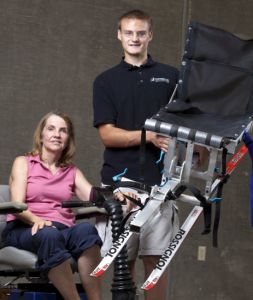
VanderSanden spent his senior year assisting in the design of a device that makes cross country skiing accessible to the disabled. The device is considerably cheaper than current models on the market and is in the process of being loaned, at no cost, to area ski clubs and parks. Read more from the Wisconsin State Journal.
Β
In Kansas City, MO, the Girl Scouts are also taking part in helping girls learn about science and technology. A new summer camp, “Inventure U Science and Engineering,” is a camp for girls to learn about robotics and other engineering fields “that have been traditionally dominated by men.”
The program is welcomed by current University of Missouri-Kansas City School of Computing and Engineering dean Kevin Truman, MO G ’78. Truman says that women make up only 25 percent of the students at the UMKC engineering school, and their perspective is needed. Read more
Π
Tau Beta Pi has taken a serious interest in supporting the efforts to increase women in engineering, and education of K-12 students in the STEM fields, through its own MindSET Program. We encourage Tau Beta Pi members to learn more about MindSET and how they can help student chapters in offering kinesthetic activities to increase math and science capabilities in local K-12 schools.

 The Official Blog of Tau Beta Pi
Interesting statistics on Science and Engineering Graduate degrees:
http://www.nsf.gov/statistics/wmpd/degrees.cfm
http://www.nsf.gov/statistics/wmpd/figc-1.htm:
“Women and men have earned approximately the same number of Science and Engineering bachelor’s degrees since 2000.
* The number of Science and Engineering bachelor’s degrees earned by women has increased almost every year since 1966, reaching 239,273 in 2006.
* The number of bachelor’s degrees in Science and Engineering earned by men fluctuated around 200,000 from 1976 to about 2002 and increased since then, reaching 234,260 in 2005.
* The number of non-Science and Engineering bachelor’s degrees awarded to women is substantially higher than those awarded to men and is substantially higher than the number of S&E bachelor’s degrees to either men or women.”
http://www.nsf.gov/statistics/wmpd/figf-2.htm
“Doctoral degrees to female U.S. citizens and permanent visa holders rose over three decades, in sharp contrast to the downward trend for men, then flattened after 1995.
* Degrees earned by men rose strongly until the early 1970s, dropped until the late 1980s, and dropped again after 1995.
* Degrees earned by women increased through most of the period until flattening from the mid-1990s onward.
* In 2006, women earned 45% of Science and Engineering and 59% of non-Science and Engineering doctoral degrees awarded to U.S. citizens and permanent residents, up from 8% and 18%, respectively, in 1966.”