
Modern technology has altered the Earth in ways that cannot be reversed. What began as a series of exciting inventions, like radio and television, has quickly led to overproduction, causing a capitalization of natural resources, pollution disrupting the balance of nature, and social isolation like never witnessed before in history. In his entry to the Tau Beta Pi Electee Essay Contest, Lt. Col. Dennis W. Varhola, USAF RET, PA Z ’71, who was pursuing his undergraduate degree at the time, addresses the concerns of modern engineering in spring of 1970, and his warnings may ring true even after 50 years.
Varhola alerts upcoming engineers of a “disastrous” future, should they not follow his advice to stay conscious of the long-term consequences of modern technology and invention. Today, we see the impacts of neglect regarding this prediction, but there is still time for engineers to use their abilities toward environmental health, resource conservation, and other methods of protecting the planet’s finite resources.
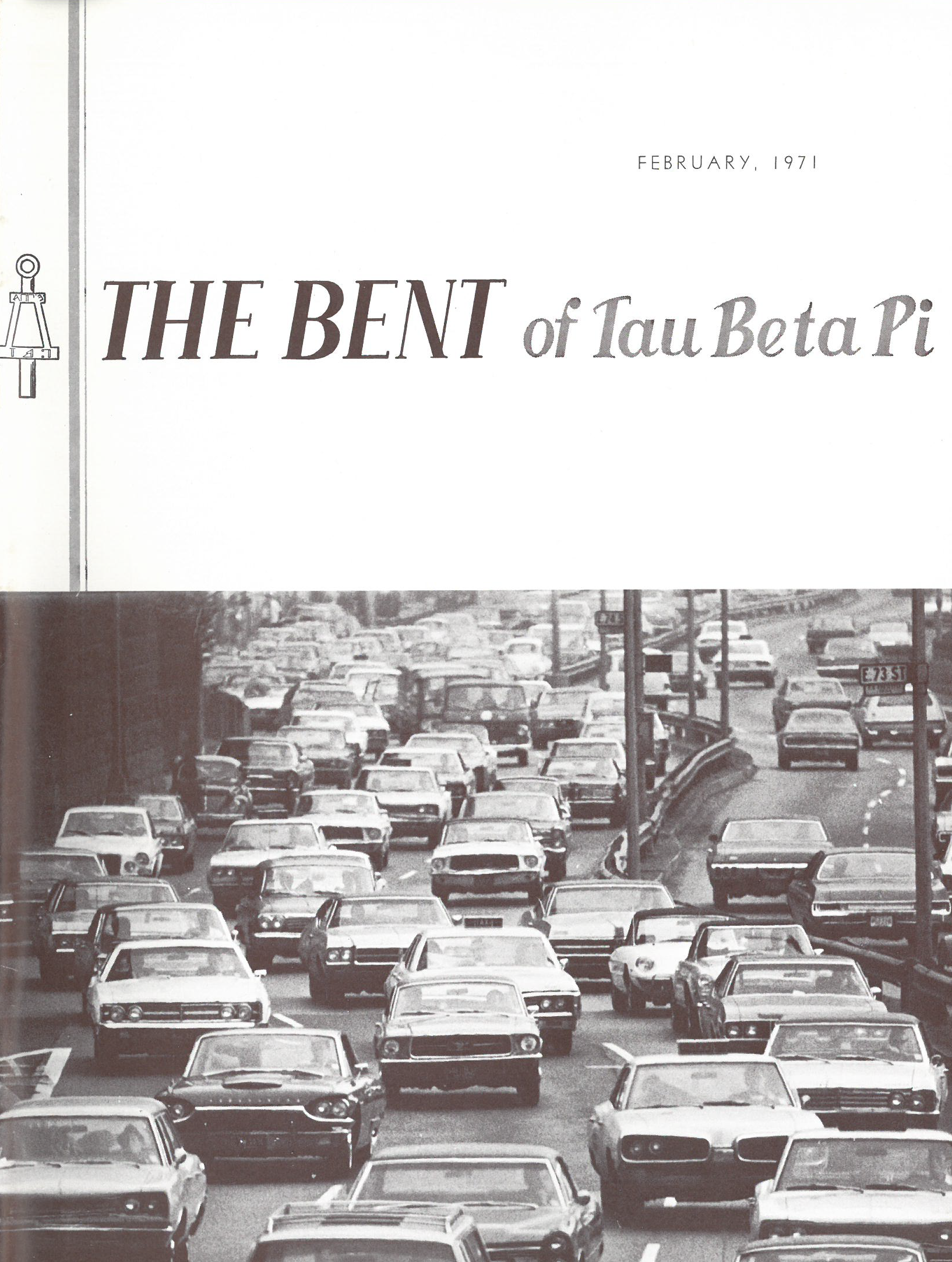
Tau Beta Pi conducted an Electee Essay Contest as a pre-initiation requirement that began in 1952 and continued for several decades; this piece won Third Place Prize of all inductee essays in 1970. The essay was subsequently published in The Bent in the February 1971 issue. We felt it would be interesting to compare the concerns of 1970 with modern-day qualms.

The “Now” Engineering
By Dennis W. Varhola, Pennsylvania Zeta ’71
It is a widely accepted notion that the spirit of a particular society during a particular period in human history has been, and indeed is now, expressed in the outpouring of that society’s artistic community. Each poet or musician, having been subjected to the social, economic, and political forces of his time and having experienced an inner molding process due to these forces, acts through his originality like a pen which records the society’s attitudes and inner feelings on the medium of artistic talent. The non-artist also, being an integral part of this society, finds himself involved in a process whereby he, through his professional skills and normal living habits, helps to create the spirit of society which in turn influences his role as a participant. Taking the specific case of the engineering profession, it is quite evident that an engineer is thoroughly involved with society at large—a fact which is becoming of crucial importance.
Since the turn of the nineteenth century, man’s culture in the developed countries has become increasingly more technical. Technological know-how has advanced at a truly astounding pace, each new development paving the way for several more new and exciting discoveries. The lot of the engineer was a pretty one: left to toy with his storehouse of interlocking pieces, completing new puzzles which resulted in the introduction of improved devices for increased efficiency in the utilization of human time and labor, devices which enable man to accomplish undreamed-of feats of amazing technical complexity. The point has now been reached where every individual in the modern world is in some way touched and impressed by the technical quality of our engineered way of living (a reasonable accomplishment for a progressive mankind), whether it be through transportation, living facilities, education, government, war, pollution, resource mismanagement, or stepped-up population growth. Which, of course, brings us to the main subject of this discussion.
If the human being is now freed of so many burdens of the past by the grace of these engineering advancements, why then is it so difficult to live in this technical era? Why does mankind find new strife and new complex problems replacing old problems, rather than true and genuine improvements? An answer to this question would be as complex as our turbulent society; however, part of the problem may be traced to the technology itself.
Along with the many great and beneficial accomplishments of the technological age have come injurious side effects, if not direct products. Pollution has been recently cited as a serious problem. Increased efficiencies have contributed to an economic imbalance and inflation. War technology has induced fear of further advancements into the generation coming out of World War II and into Vietnam. Probably the greatest and most frightening side effect is the alienation and isolation of the individual. Confronted with a technical society, one feels helpless to control the destiny of such a huge and complex machine, even to the point of uncertainty concerning his own future.
So what are we, as engineers and creators of this marvelous jumble of technical know-how and its social consequences, charged with? Just as the true artist must be sensitive to the spirit of his society, so the engineer, the conscious and concerned engineer, must recognize and correctly interpret his society’s needs, both vocally expressed and structurally implied. It is time to worry a bit; without concentrated effort and results, certain problems may reach crisis proportions during the next generation. Now is the time for a change in attitude and purpose for today’s engineer. Each one of us must recognize his importance in the determination of future social repercussions. The average engineer may have previously regarded himself more as an employee of a company than as a member of society, and an important member at that. Our responsibility as employees is still valid, but is not our responsibility as society members at least equally, if not more, important? We are the men who build things, things that will eventually enter into the lives of thousands of fellow humans. Let us then be aware and concerned of how our work will affect and alter our society, now and in the future. Only in this way, through the cooperation and concern of all men, will the age of technology be spared a disastrous climax.
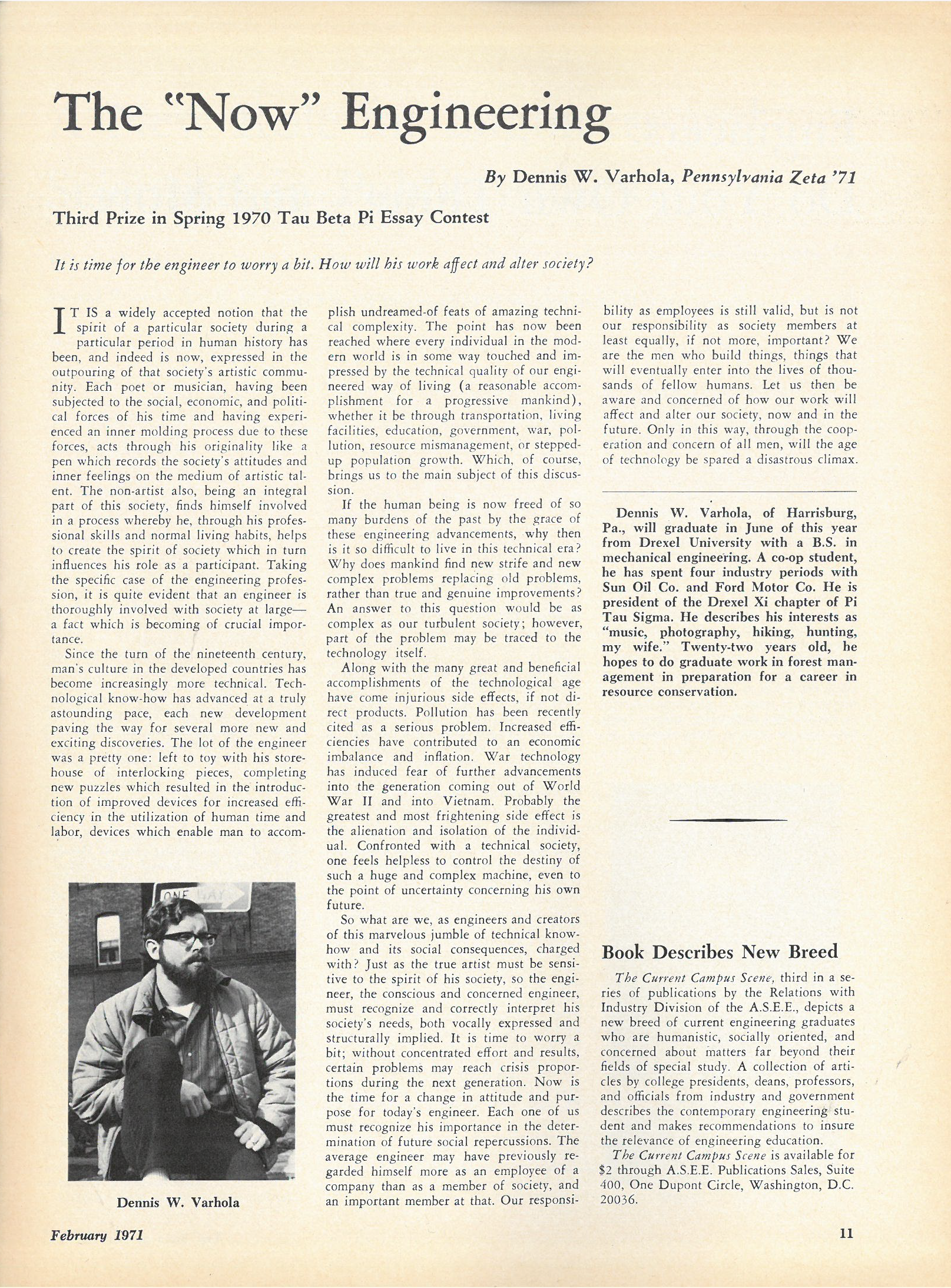
Lt. Col. Dennis W. Varhola, USAF RET, PA Z ’71, graduated from Drexel University with a B.S. in mechanical engineering. He later earned a master’s degree in aeronautical engineering from the Air Force Institute of Technology and a master’s in military sciences from the Air Command and Staff College in Montgomery, Alabama. His submission to the essay contest described his interests as “music, photography, hiking, hunting, [and his] wife.” He died in 2013 at the Wright Patterson Air Force Base Medical Center.
 The Official Blog of Tau Beta Pi
Leave a comment